

On February 28,
the Frontier Technology Forum on Medical Evidence-Based Reasoning Agents
and the DeepRare Achievement Launch Event
was held at Shanghai Jiao Tong University’s Xuhui Campus.
The world’s first agent-based evidence-driven diagnostic system for rare diseases, DeepRare, was officially released.
Guests from academia, industry, and research institutions gathered together, while multiple clinical and industry collaborations were launched simultaneously.
This initiative contributes SJTU’s knowledge and strength to improving rare disease diagnosis and treatment and advancing global healthcare.

On February 28, the Frontier Technology Forum on Medical Evidence-Based Reasoning
Agents and the DeepRare Achievement Launch Event was successfully held at the School of Artificial Intelligence on Shanghai Jiao Tong University’s Xuhui Campus. Academicians from both the Chinese Academy of Sciences and the Chinese Academy of Engineering, leading clinical experts, and AI scholars gathered to discuss the development of cutting-edge medical evidence-based reasoning agent technologies. The forum also unveiled the core achievements of DeepRare, the world’s first agent-based evidence-driven diagnostic system for rare diseases. The event built a bridge connecting academia, industry, research, and real-world applications, injecting new momentum into interdisciplinary innovation between biomedicine and artificial intelligence. It aims to improve rare disease diagnosis and treatment while promoting high-quality development in the life sciences.

Among the distinguished attendees were Ding Kuiling, academician of the Chinese Academy of Sciences and President of Shanghai Jiao Tong University; Sun Yongkui, member of the U.S. National Academy of Engineering and Director of the Shanghai Center for Drug Innovation; Zhou Bowen, Director and Chief Scientist of the Shanghai Artificial Intelligence Laboratory; Yang Shengli, academician of the Chinese Academy of Engineering and advisory member of the Second National Rare Disease Diagnosis and Treatment Expert Committee of China’s National Health Commission; Dong Jiahong, academician of the Chinese Academy of Engineering, Dean of the Tsinghua University School of Clinical Medicine, and President of Tsinghua Changgung Hospital; Mao Junfa, academician of the Chinese Academy of Sciences and former President of Shenzhen University; Fan Xianqun, academician of the Chinese Academy of Engineering and President of the Shanghai Jiao Tong University School of Medicine; Jia Weiping, academician of the Chinese Academy of Engineering and Chair Professor at Shanghai Jiao Tong University; Zhang Wenjun, academician of the Chinese Academy of Engineering and Chair Professor at Shanghai Jiao Tong University; Zhao Dandan, Party Secretary of the Shanghai Shenkang Hospital Development Center; Yuan Guohua, Party Secretary and Chairman of Shanghai State-owned Capital Investment Co., Ltd.; Lu Wen, Party Committee member and Vice President of the same company; Pan Yan, Deputy Director of the Shanghai Municipal Commission of Economy and Informatization; Huang Hong, Deputy Director of the Shanghai Municipal Science and Technology Commission; Chen Yong, Deputy Mayor of Shanghai’s Xuhui District; Wu Hong, Second-level Inspector of the Shanghai Municipal Health Commission; along with more than one hundred representatives from government agencies, academia, healthcare institutions, industry, and the investment sector who gathered to witness this important moment.
Multiple stakeholders unite to outline the future of interdisciplinary medical-engineering development

Ding Kuiling extended a warm welcome and sincere thanks to all guests. He noted that the DeepRare system is a gift from SJTU to the world, using science and technology to benefit humanity. It demonstrates the power of interdisciplinary integration between medicine and engineering and vividly illustrates the idea that “artificial intelligence is a field for young people.” SJTU has long supported young talents in taking leading roles, providing various support programs that create an innovative ecosystem where creative ideas can flourish. In the future, the university will continue to produce major original achievements with international influence, contributing to Shanghai’s development as a global innovation hub and strengthening China’s scientific and technological self-reliance.

Yang Shengli remarked that DeepRare transforms the diagnosis of rare diseases from a long “marathon” into an efficient “100-meter sprint.” It represents a strong advance toward the frontiers of life science and marks China’s entry into deeper clinical applications of artificial intelligence. He emphasized that changes in medical paradigms are driving the transformation and upgrading of both AI and medical research. “Making the rare clearly visible with AI” is a shared mission, and he hopes the team will continue to advance frontier research and contribute Chinese wisdom and strength.


Pan Yan, Huang Hong, Zhao Dandan, Yuan Guohua, and Chen Yong each delivered remarks expressing strong support for the development of medical evidence-based reasoning technologies and confidence in strengthening interdisciplinary innovation between medicine and engineering to improve rare disease diagnosis and treatment.

The opening speeches were hosted by Jiang Xinghao, Vice President of Shanghai Jiao Tong University.
Congratulatory messages were delivered by E Weinan, academician of the Chinese Academy of Sciences and Chief Advisor of the SJTU School of Artificial Intelligence; Chen Kaixian, academician of the Chinese Academy of Sciences and Deputy Chief Scientist of the National Major New Drug Innovation Program; Zhang Yun, academician of the Chinese Academy of Engineering; Cai Xiujun, academician of the Chinese Academy of Sciences and President of Sir Run Run Shaw Hospital affiliated with Zhejiang University School of Medicine; Shen Zuyao, academician of the Chinese Academy of Engineering and Senior Vice President of Nanyang Technological University; and Durhane Wong-Rieger, President and CEO of the Canadian Organization for Rare Disorders.

Ding Kuiling, Sun Yongkui, Zhou Bowen, Dong Jiahong, Fan Xianqun, Mao Junfa, Jia Weiping, and Zhang Wenjun jointly launched the co-construction ceremony for the “Artificial Intelligence and Biomedicine Interdisciplinary Innovation Center (Preparatory).”

Cai Wei, President of Xinhua Hospital affiliated with the SJTU School of Medicine; Sun Kun, Director of the Shanghai Rare Disease Quality Control Center and lead of the DeepRare clinical team; Zhou Yongfeng, Dean of the SJTU Institute of Science and Technology Development; and Zhang Ya, Vice Dean of the SJTU School of Artificial Intelligence and leader of the DeepRare technical team, jointly initiated the official lighting ceremony marking the deployment of DeepRare in the rare disease quality control system at Xinhua Hospital. This symbolized the full integration of advanced AI agents into real clinical workflows.

Wu Hong, Lu Wen, Zhou Huifang (Party Secretary of Shanghai Children’s Medical Center affiliated with the SJTU School of Medicine), Yu Yongguo (Director of the Research Office and Executive Director of the Clinical Genetics Center at Xinhua Hospital), Shen Dinggang (Founding Dean of the School of Biomedical Engineering at ShanghaiTech University and Co-CEO of United Imaging Intelligence), Yu Rong (Chairman of Meinian Health Industry Group and Tianyi Investment Group), Zhang Junjie (Vice President of Ant Group and President of the Health Business Group), Zhu Shida (Deputy General Manager of BGI Genomics), Cheng Guohua (Chairman of Hangzhou Jianpei Technology), and Xie Weidi (Associate Professor at the SJTU School of Artificial Intelligence and CEO of Shanghai Guanyi Intelligent Technology Co., Ltd.) jointly launched the “Global Ten-Thousand-Case Clinical Validation Public Initiative.”
Keynote presentations explore frontier technologies and clinical practice
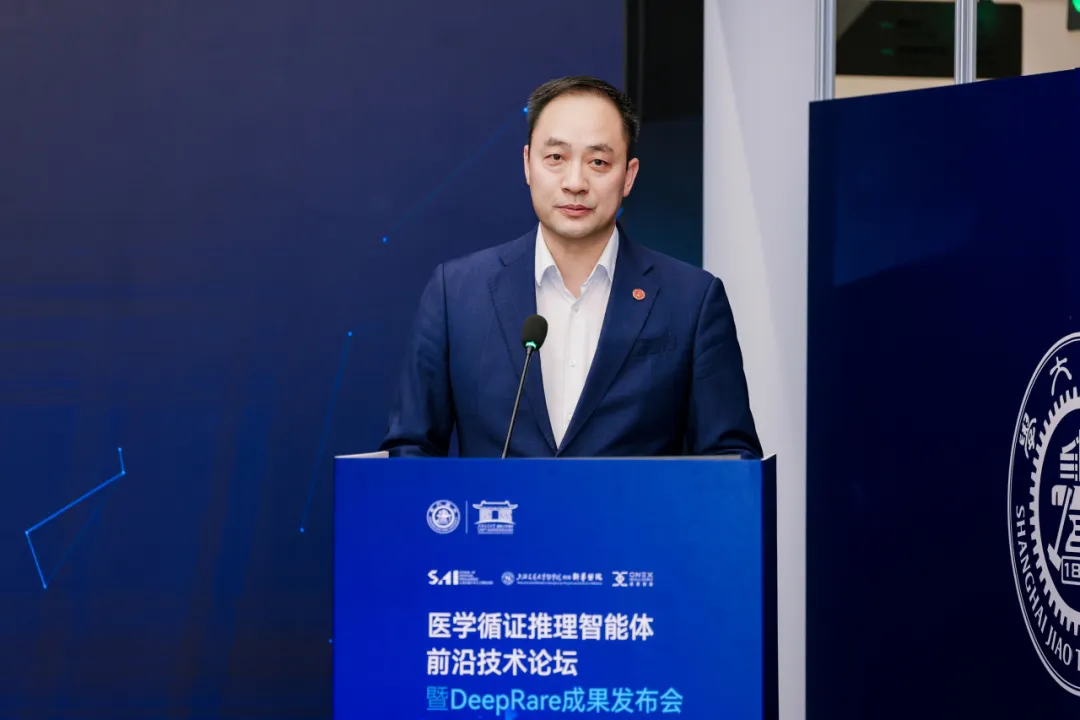
The keynote session was hosted by Wang Yanfeng, Executive Dean of the SJTU School of Artificial Intelligence.

Zhang Ya delivered a presentation titled “Core Algorithms of DeepRare: Breakthroughs in Evidence-Based Reasoning Technology.” Addressing four major challenges in rare disease diagnosis—difficulty remembering diseases, inaccurate matching of symptoms, incomplete information retrieval, and failure to consider rare possibilities—the system constructs an architecture combining real-time knowledge retrieval with self-reflective iterative reasoning. Through a central engine coordinating eight types of specialized tool agents, it enables simultaneous searching, evidence gathering, and reasoning. The “hypothesis–verification–reflection” closed loop mitigates hallucinations in large language models, sets a new global record for diagnostic accuracy, and generates traceable evidence chains to overcome the “black box” problem in medical AI.

Xie Weidi presented “From Rare Diseases to the Entire Life Sciences Domain: Engineering Simulation and Precise Prediction Driven by Agentic AI.” He explained how agentic AI is reshaping life sciences and proposed three core pillars: data infrastructure, a System-2 slow-thinking reasoning engine, and silicon-based validation. These developments promote the evolution of AI from probabilistic generation toward evidence-based reasoning, creating a traceable autonomous reasoning engine for life sciences. The paradigm has already been validated in scenarios such as rare disease diagnosis and virtual cell drug testing.

Yu Yongguo delivered a presentation titled “Finding Light in the ‘Blind Spots’: Clinical Practice of DeepRare.” He shared real clinical cases where DeepRare successfully diagnosed complex multidisciplinary conditions. He also announced a nationwide multi-center clinical validation plan involving more than 20,000 samples. By embedding DeepRare into clinical workflows and conducting large-scale “stress testing,” the project aims to evaluate human-AI collaboration, support standardized applications of AI in medical diagnostics, and help address the global challenge of rare disease diagnosis.
According to reports, the DeepRare online diagnostic platform officially launched in July 2025. To date, it has attracted more than 2,000 professional users worldwide and is used by over a thousand medical and research institutions. The successful forum and launch event provided an important platform for collaborative innovation across academia, industry, research, and application, showcasing China’s major breakthroughs in medical intelligence and pointing the way for interdisciplinary innovation between artificial intelligence and biomedicine.
As the technology continues to mature and expand, Shanghai Jiao Tong University will further promote improvements in rare disease diagnosis and treatment, support high-quality development in the life sciences, and contribute Chinese wisdom and strength to the advancement of global healthcare.

A gift from SJTU to the world
DeepRare: AI makes rare disease diagnosis no longer “rare”

Source: School of Artificial Intelligence
Photography: Visual Creativity Center and others
Editor: Zhou Xinyi
Responsible editor: Chen Chen
Translated by: Rebecca
Proofread by: Denise


